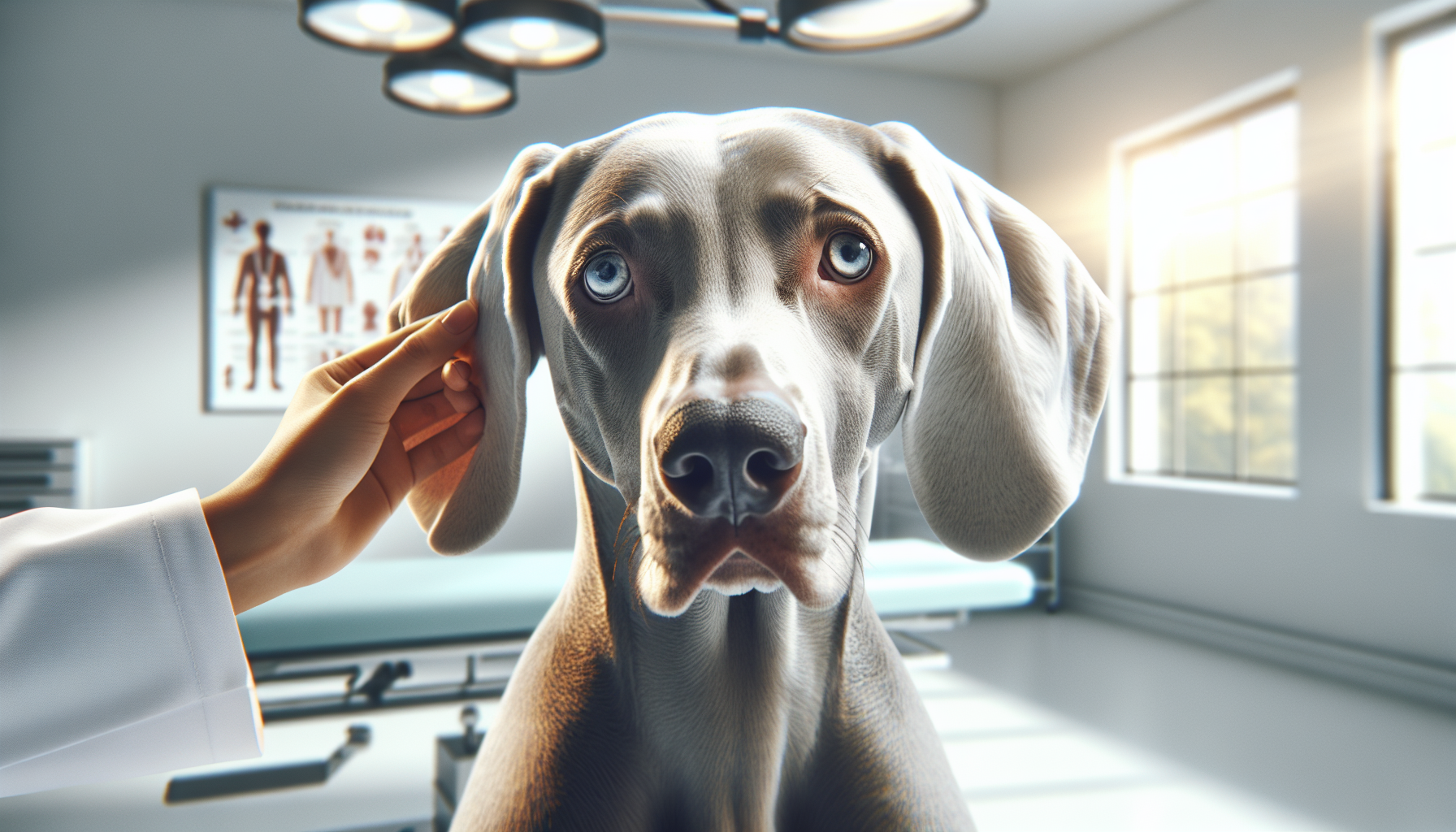
A Honest Take on Weimaraner Health Issues
Here’s my controversial opinion: most Weimaraner breeders aren’t being honest enough about the breed’s genetic issues, and buyers are strolling blindly into a minefield. I can say this because I love Weimaraners more than anything: I have owned three of them over a fifteen year period. I can also say this because I’ve spent thousands of dollars trying to treat health problems that I could have avoided altogether had I been aware of them in the first place.
When I bought my first Weim (Ghost, a lovely silver female), the breeder told me that the breed was “generally healthy.” Now, that’s an accurate statement in the same way that saying a motorcycle is “generally safe” is accurate. Compared to the breeds that have breathing problems, hip deformities and hard, slow deaths before the age of five, Weimaraners aren’t all that broken down. Still, caveat emptor.
The Bloat Problem Nobody takes seriously enough
Gastric dilatation-volvulus, or bloat, is the thing that keeps well-seasoned Weimaraner owners awake at night. I’m not being overly melodramatic. Bloat can KILL your dog within hours, and Weimaraners are prone to it due their deep chests.
It happens like this: stomach fills with gas then twists on itself, cutting off blood flow, leaving your dog in shock. When you get to the emergency vet, you may find you’ve already crossed the line into surgery territory and, even after that, survival isn’t guaranteed. My second Weim, Atlas, experienced a bloat scare when only four years old.
We caught it early because I was in the house that day and noticed he was having a hard time vomiting and the vomiting wasn’t doing anything, his stomach was distended, and he was pacing like he knew if he didn’t find help he’d die. We got to the emergency vet with what I now know was a life-threatening condition in about 30 minutes. The bill was $4,800, and this was one of the more affordable outcomes because his stomach hadn’t fully twisted yet.
Some pet owners will choose to have a gastropexy routinely performed while the dog is spayed or neutered, so the stomach can’t twist. I’m not 100% certain whether I think that’s necessary in every case, but after what happened with Atlas, I would certainly entertain the idea before I purchased another Weim. The gastropexy costs an extra $300-500 and might end up saving your dog from an unexpected, grisly night in the ER costing an order of magnitude more.
Do small meals twice a day, not one big one. Keep them away from gulping food or water right after running around or exercising. No raised food bowls – even though you might have heard otherwise, there are studies showing raised bowls are more likely to induce bloat in large breeds.
And learn the symptoms inside and out before you need to know them.
Hip Dysplasia and the Breeding Problem
Every large breed has issues with hip dysplasia, but here’s where I really argue with people: I think a lot of Weimaraner breeders are still casually breeding dogs without proper, veterinary-verified hip issues, and buyers are so enamored with pictures and blinkered by affection that they forget to ask questions. Hip dysplasia occurs when the hip joint doesn’t form correctly.
The consequences are arthritis, pain and risk of break-down. The condition is genetic and can be rehabilitated with responsible breeding decisions. Ask for OFA certification on both parents.
Don’t ask because the breeder says “oh all the dogs in the line seem fine” or “there’s never been any problems”. Ask for results, not just hearsay. If a breeder gets huffy about your request or implies that testing isn’t necessary simply because their original dogs don’t have problems, run.
There are breeders to be found who are conscientious about this. Ghost developed hip dysplasia at age seven. In hindsight, I can say for certain I never asked for any type of health testing.
Looking back at the twenty-something girl who bought her, I was just happy to have a puppy to love and the breeder seemed trustworthy. That’s just not good enough. We managed it with supplements, weight control and then medication, and she managed to get to age twelve.
The last couple of years had plenty of attentiveness while she struggled to ascend the stairs, avoid street stairs, helped her get into and out of the car, and lived day-to-day with some level of mobility; all of these things could be avoided the second time around.
Broader Breed Issues You Won’t Find in a Guidebook
Beyond the big money health issues, there are a host of other recurrent problems unique to the breed: mast cell tumors (a particularly aggressive form of canine skin cancer) are correlated with Weimaraners having higher rates in the breed than others. If you see a lump or a bump, don’t be lazy about having it checked out by your veterinarian.
I mean this as much for the, “I’ve always wanted to have that checked” variety as I do for the, “I’ll get around to that someday” kind. Hypertrophic osteodystrophy affects Weimaraner puppies specifically and is best characterized as a bone problem rather than a breed-specific health problem. The disease manifests as painful swelling in the growing legs among dogs between 3 and 6 months of age.
There is a possible link with certain vaccinations, but the data remain inconclusive. Talk this over with a familiar breed vet. Thyroid function is another apparently-normal dog consequence that turns out to be typical for the breed, since Weims tend to be prone to thyroid abnormalities.
If your vet notices your dog is gaining weight despite normal food consumption, or losing hair, or just appears to be perpetually fatigued, check his thyroid function. Even the simplest blood tests can be unearthing; daily thyroid medication costs pennies. And while we’re talking about common health issues, let’s touch upon the “heartbreak more specific to this breed, namely, separation anxiety.
I know it’s not technically a biomedical issue, but I can promise you they’re born with it: We’ve imaraners seem to be innately predisposed to shedding, breaking out of crates, smashing windows, and eating drywall when they haven’t been exercised and left in a boring environment for a while. There’s no way around it. Weimaraners are not dogs people can work full-time and vacation full-time without.
What would I change if I could?
If I could start all over today with a Weimaraner, I would insist on puppies being born from proven outside hip certification, give the breeder I chose an immediate advanced payment so he’s not concerned if I ask detailed information, get pet insurance ASAP, find a Weim-specific veterinarian and not wait until I’m desperately trying to get urgent care, and not go in with my heart set on a cute puppy, but an intelligent plan in mind. If you go in armed like this, you’ll have happy memories and every reason to have great Weimaraner experiences. If you don’t, well.. experience.
Pleasure?
Is an uncertain thing.