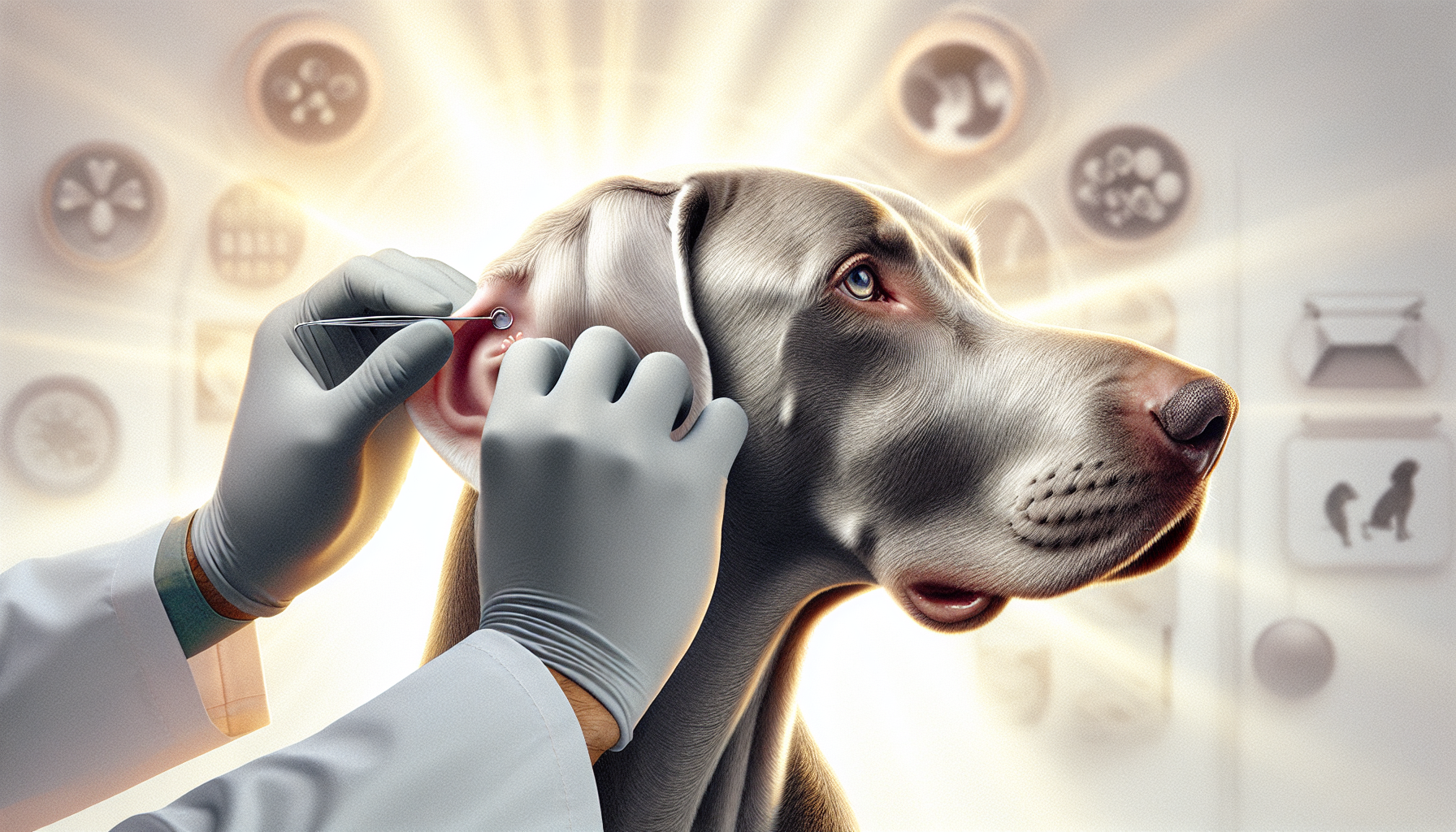
Why does my Weimaraner keep getting ear infections?
I get that question at least twice a week, usually from someone who’s already been to the vet 3 times this year and is starting to wonder if they adopted a dog or a habitual money drain with legs. Honest answer: your Weimaraner gets ear infections because you have a Weimaraner. That’s it.
That’s the main reason. Those beautiful, velvety, floppy ears that make them look like aristocratic hunting dogs painted by someone in the Renassiance?
They’re basically petri dishes attached to your dog’s head. I learned this the hard way with my first Weim, Duke. I was doing everything right.
Quality food, frequent visits to the vet, lots of exercise. Then one day he was shaking his head like he was at a heavy metal concert, and I discovered that “ear infection” was going to become a recurring fact of life and a recurring expense. The anatomy is working against you from the beginning.
Weimaraners have L-shaped ear canals that sit under those enormous ears, creating a humid, warm environment with little to no airflow. Bacteria and yeast go crazy for this environment. It’s like you’ve built them a luxury hotel in your dog’s head.
They’re going to move in, invite their friends, and destroy the place. But here’s one thing that surprised me, and honestly still infuriates me when I think about it: the diet connection is real, but vets aren’t always upfront about that. When I switched Duke off chicken based food, those chronic ear infections decreased about 80%.
Not because chicken is bad, but because he had become intolerant to it, and problems with food allergies in dogs tend to manifest as ear infections first. Not a digestive upset. Ears.
Nobody tells you this in advance. I’m not 100% sure this applies to every Weimaraner with ongoing infections, but I’ve spoken to enough people over the years to know it’s way more prevalent than most think. If your dog’s ears are forever inflamed no matter what you do, try an elimination diet before you fork out another two hundred dollars on medicated ear drops just to get the symptom under control.
The Prevention Plan That Works
What I do now, and enjoy better results from than the generic advice you’ll find on most pet sites, is the following. First, I dry Duke ears after each and every water related activity. Every swim, every bath, every walk through wet grass in the morning.
I take a soft towel and gently dry the outer ear and the entrance to the canal. Never any deeper- keep anything out of there-only the parts you can easily reach. The reason for this choice is simple physics: moisture plus warmth plus time means microbial growth.
If you can eliminate the moisture, put a stop to the equation. Second, I do a weekly ear cleaning with a vet approved solution. This is where I’ll give you an opinion I’ll justify: most over the counter ear cleaners are garbage.
They’re either too mild to actually dislodge wax and debris, or they leave residues that mean a building pile of problems. Ask your vet what they recommend. Pay the extra fifteen dollars.
It makes a difference. The cleaning process itself isn’t complex, but people overthink it or, worse still, underthink it. You want to fill the ear canal with solution, massage the base of the ear for about thirty seconds (you’ll hear a plopping sound, this means you’re doing it right), then let your dog shake their head like an absolute maniac.
This is non-negotiable-they have to shake. Then wipe out what you can reach with cotton wool (not Q-tips. Cotton wool.).
Third, and this is the one nobody wants to hear about: flip those ears back when your dog is just relaxing. I know, it looks daft. Duke looks like he’s wearing his ears in a pony tail.
But allowing those ear canals to get some airflow, even just for an hour while he’s snoozing, makes a real difference over time. Some people buy commercial ear bands for this. I just trained Duke to accept me gently folding his ears back when he’s cooling out.
Fourth, examine the ears every week. Sniff them. I know that sounds odd, but a healthy ear smells like nothing, maybe just a little bit waxy.
An infected ear smells yeasty, sour, or even rotten. You’ll catch problems early if you develop this habit and don’t leave it until your dog is scratching their head and whimpering. Here’s something about Weimaraners that really struck me: they are dramatic.
When they get an ear infection, they’ll act as though the world is coming to an end. Notwithstanding the head tilting, the whimpering, the face pawing. It’s intense.
But this can actually be helpful because you’ll typically catch the signs early if you pay attention. Other breeds will suffer without a sound until the infection is advanced. Weims will make sure you know from the first twinge of discomfort.
I should mention that certain Weimaraners, despite diligent efforts, are simply born with chronic ear issues. Genetic factors are involved, had some underlying allergy, and sometimes it doesn’t matter how much you try you’ll still be at the vets twice a year. That’s not your fault.
It’s just the state of owning a breed whose ears were engineered by someone who appears to have never contemplated bacterial growth patterns. My last tip: keep a mini ear care pack in your car. Solution, a few cotton wool balls, a small towel.
Your Weimaraner will inevitably find water when you’re far from home- a muddy pond during a hike, a friends swimming pool, a sprinkler they just had to investigate. If you dry and clean the ears within an hour of exposure rather than waiting until you get home you’ll prevent more infections than anything else you could do.