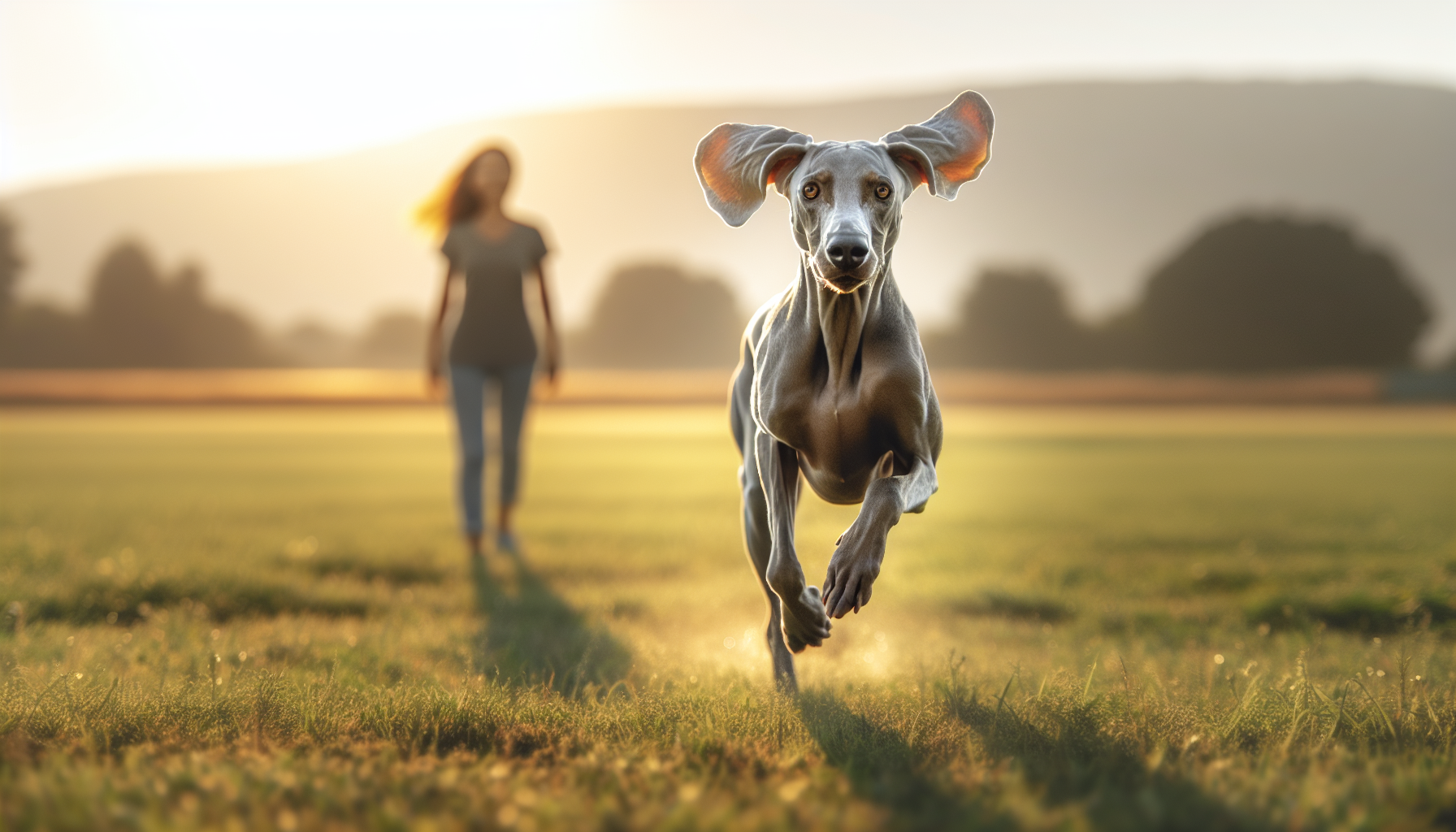
A reliable recall is worth more than the sum of all the other tricks your Weimaraner knows. I will fight anyone who disagrees. I have seen so many people dedicate months to in-betweens, hand shakes, and grooming before finally making progress, meanwhile their dog is trying to run out of the room every time you open the door.
I was that person once. My first Weimaraner, Duke, was a master of covering his paws in peanut butter and stacking a pile of sheep poo on the coffee table on cue. But he had absolutely zero reliable recall.
So when he saw a deer and broke away from me to gallop across the busiest street in town?
The tricks I spent months training meant nothing. I was screaming “come” while he ran off while I looked on helpless. That moment in my life was a turning point in how I approach obedience training.
The Weimaraner problem nobody tells you about…and wish they had.
Here’s the thing I wish someone had told me before I brought home my first grey ghost… Weimaraners are bred to hunt alone.
This is not a flaw. It is literally what they were bred for. For hundreds of years, these dogs ranged great distances from their handlers and tracked animals through German forests, making decisions in their own best interests.
That nature is ingrained in their very DNA. So when your Weimaraner ignores your recall to investigate a smell in the grass, it isn’t disobedience. You are fighting hundreds of years of breeding.
That is difficult to work against, but not impossible. What I am sure is possible though, is to build a reliable recall that is good enough to function in most situations. And that has saved my current dog Finn’s life more times than I can count.
Building a Reliable Recall
Instead of tools I thought I needed more of, like higher-value treats and better toy rewards, what I learned through a lot of trial and error was to work on my recall in broadening environments with increasingly entertaining environments to make the command “come”. Dogs are not perfecting generalizers and so your “come” in your living room does not have instant transferability to the dog park. You need to build that bridge, think of it like a ladder, gradually reaching further and further into new environments for continued months.
First your backyard, then a quiet park, then at a distance from other dogs, then at a distance from squirrels, then at a park that is busier, then at a park that has other dogs. It takes months, and there’s no way around the time spent in new environments. Anyone selling you a quick fix is lying.
The Long Leash Method
One thing that surprised me was how much having a long leash developed our training. I keep a 30 or 50-foot leash for Finn all over the place with us, and we used it relentlessly for months. It was not a punishment device; it was insurance that if he ignored my recall, I could easily reel him in.
No punishments, just gentle guidance. I think simply taking away the comfort of being able to ignore me helped the most. The rule I follow for recall above all else with my current dog.
Never Call Your Dog to Do Things They Don’t Like
Never, never call your dog to do things they are not going to like. Remember, keep your dog outside the “don’t want to” situations until recall is just as ingrained as the every day commands. And give your dog something incredibly fun to do once they get to you.
Every time I grab Finn, I make sure I go above and beyond with praise, then let him go again. Expect to do this a couple hundred times before your dog starts “coming” without stopping in the doorway when you need to leave him alone. With the old guy I had to leave in the yard while I went to the 24 hour gas station for an hour thirty to manage the “what I don’t want to do” situation.
Now that I have Finn, I just put him back out there and get the hell inside when it’s time. That command is valuable, and it needs to be protected. All I want is a reliable, living-proof recall.
Consistency is Key
Whenever someone asks me how often I work on recall with my older dog with the long line and blanket command, the answer is, every single spare second I have, sometimes fifteen to twenty times a day. Each time I call him, it takes no more than ten seconds, and I reward every time. Why?
Because you are forming a habit. If you say “come” enough in a situation where “come” is expected, then it becomes automatic. Your dog “comes” because that’s what they do.
Repeat that environment many times; eventually, “come” becomes ingrained in the dog’s mind. You want your recall to be as impressive as it is simple.