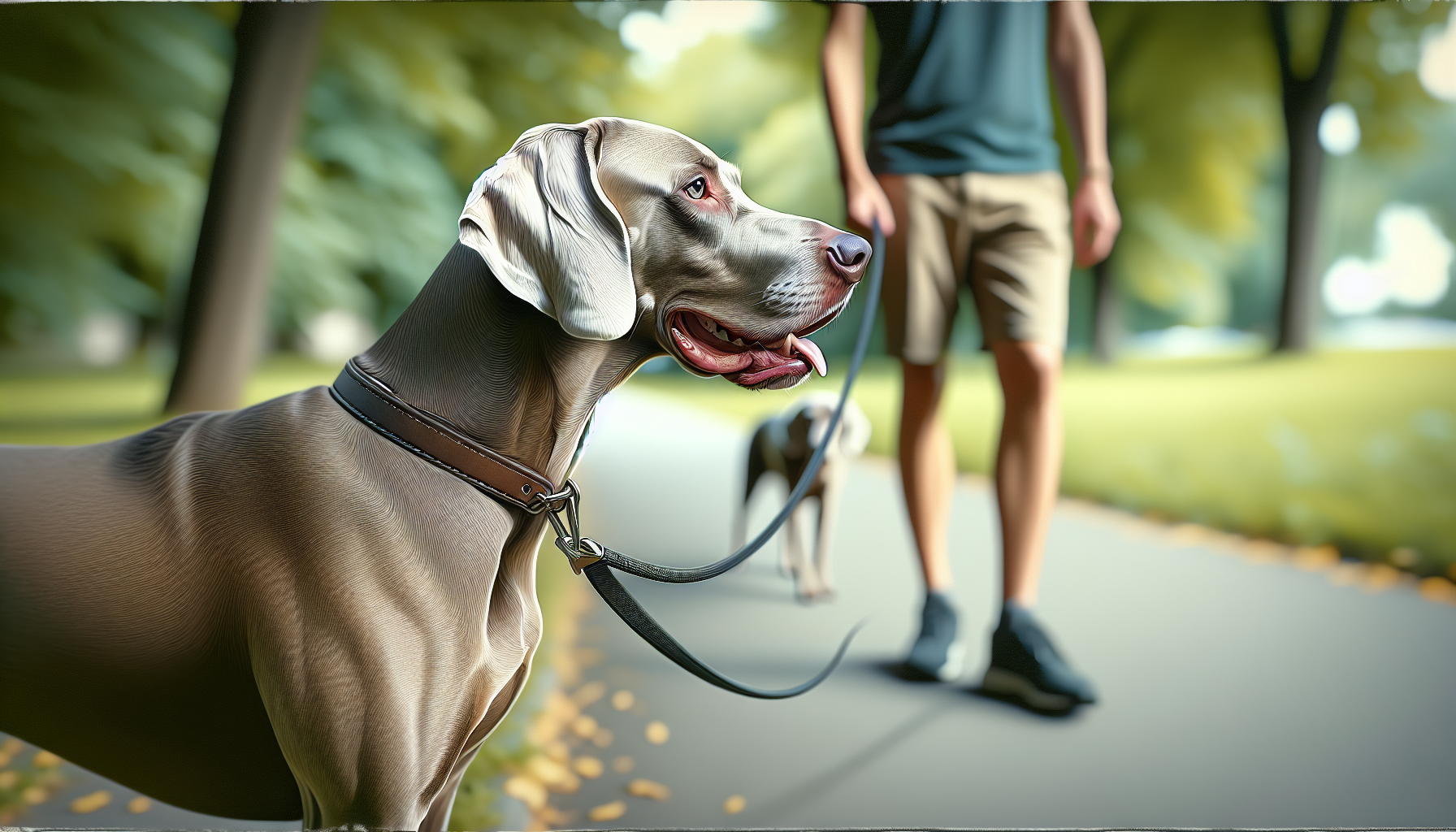
—and that’s the problem right there. You’re standing there, leash coiled around your fist, watching your Weimaraner blow their mind at some poor golden retriever down the street, and you’re asking yourself, ‘what did I do wrong?’. Let me tell you.
It’s the same thing I did: Weimaraners are intense. That’s not a flaw, it’s a characteristic of the breed. Weims have been bred to hunt big game, to have pinpoint visual acuity, to have quick reactions.
And take that genetic disposition, combine it with a six-foot leash, and what you get is a pressure cooker. Your dog sees a dog, can’t do what their instincts demand they do (approach, investigate, evaluate), and that will drive an attack response like nothing else. Here’s what took me a while to realize: my dog wasn’t really aggressive.
Down at the dog park?
No problem. On-leash?
Disaster area. It took me embarrassingly long to realize the leash was half the problem.
The Real Reason Your Weimaraner Is Loosing It
Leash reactivity boils down to frustration, fear, or an anxious combo of both that your dog has practiced so many times they can do it in their sleep.
And yes, practice is the right word: every time your dog lunges and that other dog goes away, your Weimaraner believes their lunge was successful. You’ve inadvertently taught this response by allowing it to work against you. With Weimaraners, I suspect frustration is most often the culprit.
These dogs are too curious for their own good. They want to greet, to explore, to keep tabs on everything going on. The leash locks them in place, tension mounts, and you’ve got yourself a barking, lunging, feral mess.
Another factor not nearly discussed enough is trigger stacking: your dog may be able to handle seeing one dog just fine. But if they’ve already seen two or three others?
Heard a loud truck rumbling past?
Now they’ve already got a high baseline of arousal, and that third dog is now the straw that breaks the camel’s back. This is why your Weim seems “ok sometimes” and howls the next; context is EVERYTHING.
I have a hard time believing this next part, but I think Weimaraners also have a lower threshold for leash pressure than other breeds.
They’re naturally responsive. Physically and psychologically they are hyper-sensitive, and they pick up on tension in the leash even when nothing you’re doing registers consciously. A tight leash translates to, something’s wrong here, and that raises your dog up before they can even get to the interesting part (something’s wrong here).
What’s ineffective (and what isn’t)
I’ll save you the trouble: yanking the leash, raising your voice, “correcting” with prong or e-collars. Top trainers on YouTube swear by those tools. Correction is a good start, but it’s not remedied the cause.
You’re just suppressing the behavior, and suppressed behaviors can be even worse once they break loose. What does work?
It takes some time, but it works:
Step One: Determine your Weimaraner’s threshold distance
That is, what is the closest point they can encounter another dog before they blow their mind. Some Weims might have a hundred and fifty feet. Others?
Two hundred fifty feet. While out training, this measurement is crucial. If you push too close too fast you’ll be exactly where I was, training your dog to pass other dogs at the speed of a glacier.
She didn’t get better, she got worse.
Step Two: Correct the emotional response
Also known as counter-conditioning.
When at your dog’s threshold distance start offering high-level treats, real cheese, chicken, if you can. Make this the biggest, yummiest thing your Weim has ever seen, right alongside that other dog. Do hundreds, not dozens, of repetitions.
For this to truly work your dog must be repeatedly exposed to the high-values while exposed to the other dog and that other dog remains a harbinger of good things.
Step Three: Teach an incompatible behavior
Tough dogs can’t lunge if they’re watching you. “Watch me” or “touch” are good choices.
But you must proof these behaviors in environments that are still comfortable for your dog first. Sending your dog to heel when a dog is looming two feet away is a recipe for failure (trust me, I was there).
Thus-far” management is not cheating.
If you have to walk a long way to cross the street to avoid dogs, do it. If you have to leave the trail and walk on the road, do it. Protecting your Weim from situations it cannot self-regulate in yet is smart.
It’s not a cop-out, it’s a survival skill. Every failed walk is a jarring regression in your training.
The Long-Term Plan
When working with your Weimaraner, this behavior won’t go away overnight.
Maybe not ever in a week or even in a month. If your dog has been working through reactivity for years, you’re looking at a heck of a long road: six months to a year of dedicated work. And I know.
That’s not what you want to hear. Sure, good walks are the result of good exercise, but physical fatigue isn’t the silver bullet. And yes, Weims are “tired” are a little less reactive.
But the emotional component isn’t addressed by exhausting your dog. Pavlov’s classics: mental engagement prior to those walks-wolfing down treat stuffing toys, training…do you that before you go, near or beyond your dog’s threshold, can radically alter the degree of reactivity you encounter.
Seek professional help-they should be a CPDT-KA, CAAB, or IAABC. steer clear of dominance, alpha dog, coach in a barrel type banners.
That’s pure fluff, and it exacerbates reactivity in many cases. Your Weimaraner isn’t misbehaving. They aren’t unwilling to comply, they’re overwhelmed and terribly unsure what to do.
Your job is to break down skills into the smallest, and most reasonable, pieces and to teach them at your Weim’s personal, individual pace. Some days it will be as if you took two steps back. That’s normal.
Your Weimaraner on our recent walks-shabby, boring, uneventful, nothing special-winning were worth absolutely everything I went through for that every single time.