Why Your Weimaraner Chewed Your Drywall (Again)
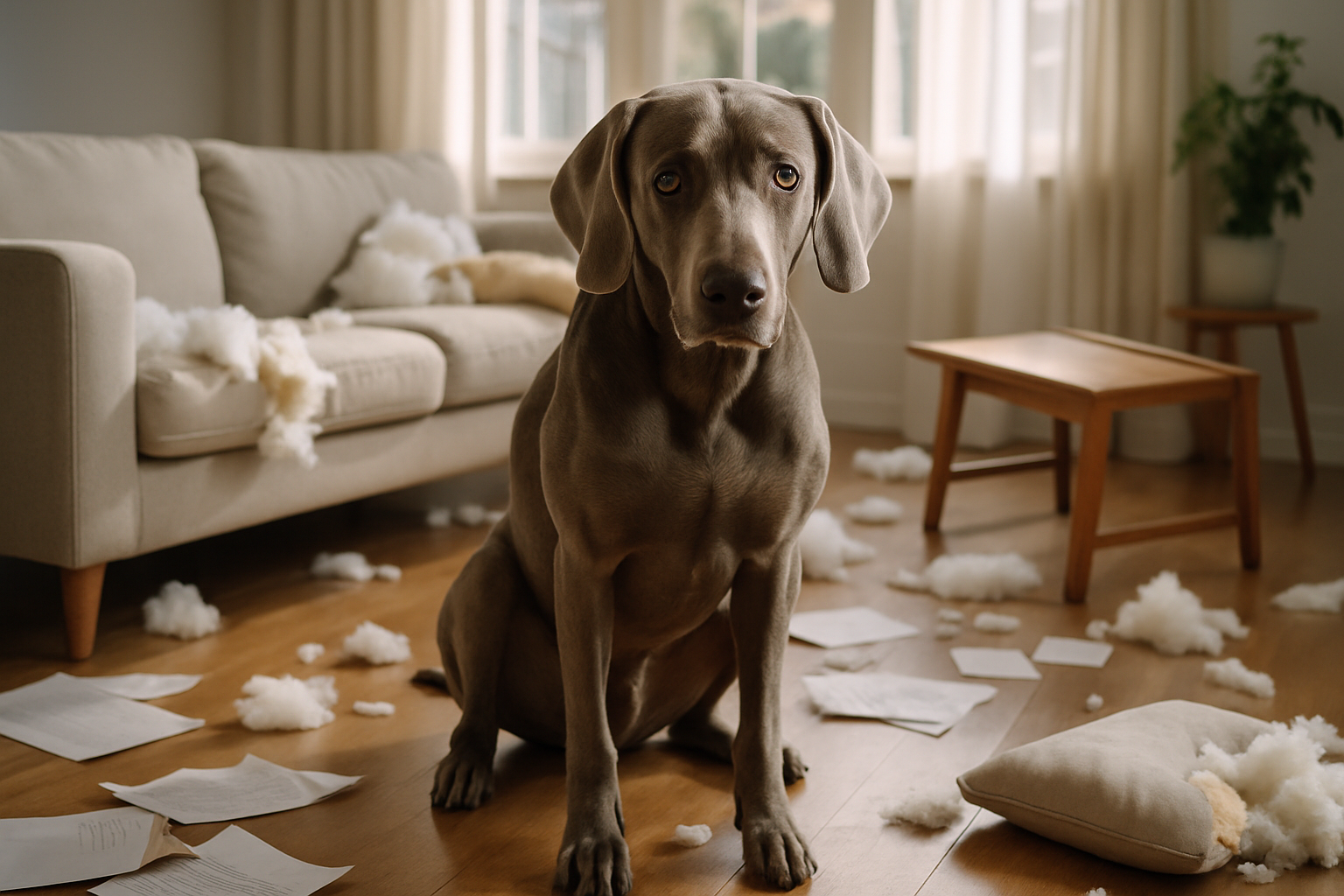
and that’s precisely why your Weimaraner chewed your drywall again this month (for the third time now). Hey, I get it. You get home from work/the store/a friend’s and it looks like your entire living room was a crash site during a cushion rave.
Your blinds are shredded, your sofa is a pile of stuffing, and you turn the corner into your dog who is somehow playing in the debris like it’s just another Tuesday. Perhaps there’s a new hole in the doorframe. Maybe your neighbor called you in tears about the dog barking.
This isn’t maliciousness. This is your Weimaraner doing exactly what a Weimaraner does when left unattended and unprepared.
The Real Reason Why Your Weimaraner Acts Like a Tiny Border Collie on Caffeine
Weimaraners weren’t bred for “chill time.” They were designed from the ground up to work and hunt with humans all day long. Seriously, not part of the day. The whole darn day. The breed is known as the “velcro dog” because, well, they quite literally cannot tolerate being separated from their humans. It’s not a behavior you can fix with some stern words or a good scolding.
It is woven into their genetics. When you leave your Weim alone without proper prep, their little brains go into a state of pure, unadulterated panic. The destruction isn’t anger. It’s fear.
I know this firsthand; my first Weim completely destroyed a door frame while I was only out of the house for four hours. I naively assumed she’d sleep, as most dogs do. Nope. I didn’t even know a 70lb animal could physically remove a door frame. Cost $400 to repair (that was 15 years ago).
Here’s what might shock you: just exercising your Weimaraner isn’t enough. Yes, the general advice for dogs is “a tired dog is a happy dog.” That’s true for 99% of breeds, but not Weimaraners. I have had Weimaraners run miles in the morning and then still chew up their bed by lunchtime.
The problem is not a physical excess of energy, it’s a severe emotional distress. Your Weimaraner truly believes you are never going to come back. It sounds melodramatic. It is the breed.
I’m not sure of the exact science, but my experience suggests that Weimaraner separation anxiety is somehow tied to their extremely high attachment levels; when they are alone, stress hormones spike to levels that wouldn’t occur in less co-dependent breeds.
What Works (and What Doesn’t)
Some Weimaraners can do crate training, but not all. And let’s get one thing out of the way right now: if your dog is hurting themselves in the crate—breaking teeth, bending bars, drawing blood—stop using the crate. That is not a “stubborn” dog, that is a psychologically tortured animal trapped in an inescapable situation. I don’t care what your dog trainer said. Crate training your Weim should never result in physical injury.
I have found that desensitization training works, but it is painfully slow. Think leaving the room for 30 seconds and coming back in—over and over for weeks on end, gradually increasing the time. Any sign of distress from your dog and you have gone too far, too quickly. There is no shortcut.
Puzzle toys and stuffing their Kongs full of frozen peanut butter only last about 20 minutes at best. They are better than nothing, but do not assume they will magically keep your Weim entertained and content while you’re gone for 8 hours.
The most consistent solution is actually the simplest: don’t leave them alone when at all possible. I know, I know—you’re probably thinking, “How can I avoid leaving my dog alone?” Here are some options:
- Take them to doggy daycare
- Hire a pet sitter
- Work from home if possible
- Take them to the office with you if you can
These are not band-aids; this is actually providing your dog the fundamental emotional support they need. For Weimaraners, it is the equivalent of asking how to cure a fish from drowning: put them in water.
In fact, I’ve heard stories of Weimaraner owners who, given their demanding travel schedules, had to completely reevaluate their lifestyle, even considering relocating to properties designed for modern urban living like a KLCC freehold residence, to better accommodate their dog’s needs or deciding the breed just wasn’t a good fit. Sometimes, you simply have to admit your lifestyle isn’t suitable for a Weimaraner.
Don’t Fear Medication
Some vets may be hesitant to prescribe anti-anxiety meds for dogs, but some Weimaraners simply have severe separation anxiety that training alone can’t fix. You are not weak for giving your dog medication. My current Weim was on fluoxetine for eight months while I worked intensely on desensitization training. She is now off the medication and can tolerate about four hours alone with zero issue.
Medication isn’t about drugging your dog into a state of blissful ignorance; it’s about making them comfortable enough in their own skin that they can begin to overcome the irrational fear associated with being left alone. Find a veterinary behaviorist, especially if your vet isn’t understanding the nuances of the breed.
Realize Your Dog May Never Be Truly Independent
The reality is, your Weimaraner might never be a dog that can be left alone for an eight-hour day without incident. That’s just the breed. Progress looks different for this breed, and even going from destruction in 10 minutes alone to 2 hours alone is a massive achievement.
Don’t compare your dog to your neighbor’s Lab who happily naps from 9 to 5; they’re built differently.
Record Your Dog
When you’re out, use your phone’s camera to see what they’re doing. Are they panting and pacing for the first hour, and then settling down? Or are they freaking out the entire time you’re gone? This information is crucial in determining the severity of the separation anxiety and how to best approach treatment.
Keep Perspective
Keep in mind that as your dog ages, the destructive behavior will decrease significantly, typically around 4 or 5 years old. They do mellow with age.
The Departure Trick
Try this: When you’re leaving, throw your dog a frozen Kong and walk out the door without any fuss. No long goodbyes, no reassuring words, just leave as if you’re just running to the mailbox. This lessens the anticipation of abandonment.